How to Gamify Fitness: Picking an App That Keeps You Going
You closed your rings for a week, maybe two, and then the badges stopped feeling like anything. Now you are looking for a fitness app that turns training into a game, and every listing promises the same points and streaks.
 CharacterSheet is an iPhone and Apple Watch appPoint your iPhone camera at the code to install it.
or text me the link
The short answer
To gamify fitness, you need four things: points for the training you do, levels those points add up to, a streak or goal with a deadline, and something you stand to lose if you stop. If you have an Apple Watch, you already have part of this for free. The Activity rings give you three daily goals, the Fitness app hands out awards for records and streaks, and you can challenge a friend to a 7-day competition (see what Apple already does).
The rings measure movement, not training. They do not care whether you lifted, ran or stretched, they do not get harder as you get fitter, and missing a day costs you nothing but a broken streak. If those gaps are why you stopped, a gamified fitness app can fill them. The checklist below (see what to look for) is built from what randomised trials found works, so you can judge any app against it, including ours.
What your iPhone and Apple Watch already do
Before paying for anything, know what is in the box. On Apple Watch, the Activity app tracks three rings: the red Move ring counts active calories, the green Exercise ring counts minutes of brisk activity, and the blue Stand ring counts the hours in which you stood and moved for at least a minute. Apple says you can earn awards for personal records, streaks and major milestones.
The part people skip is competitions. They are the closest thing to a real game Apple ships, and competition is the game rule with the most lasting effect in the trials below (see the evidence). To start one on watchOS 27:
- Open the Activity app on your Apple Watch and tap the Sharing button.
- Tap Invite a Friend, pick a contact with the Digital Crown, and wait for them to accept.
- Back on the Sharing screen, select that friend, scroll down and tap Compete.
- Tap Invite, then wait for your friend to accept.
A competition lasts 7 days. You get a point for every percent you add to your rings each day, up to 600 points a day and 4,200 for the week, and whoever has more points at the end wins.
If that is enough to keep you moving, keep using it. It is free and already on your wrist.
What the trials say works
Two trials from the University of Pennsylvania are worth knowing, because they tested specific game rules on real adults over months rather than days.
Families with points to lose. In a trial with 200 adults from 94 families in the Framingham Heart Study, everyone got a step goal and tracked their steps with a wearable or a smartphone. The game group started each week with 70 points and lost 10 whenever the family member picked that day had missed the goal, and their weekly total moved the family up or down a level. Over 12 weeks, the game group added 1,661 daily steps over their starting average, against 636 for the control group. In the 12 weeks after the game was switched off, the game group was still 1,385 steps up, against 798.
Points you can lose, with partners or rivals. The STEP UP trial followed 602 adults with overweight or obesity from 40 US states, all employees of the consulting firm that co-funded it, each wearing a wrist step tracker. For six months, the game groups got points up front each week and lost them when they missed their daily goal. They moved between five levels, starting in the middle, and the points reset every week for a fresh start. Some played with a supporter, some on a team of three, and some on a weekly leaderboard against two others.
All three game groups walked more than the control group during the six months: 920 extra daily steps with competition, 689 with a supporter and 637 with a team. In the three months after the games stopped, the competition group kept the biggest lead, 569 steps a day, and it is the one arm the authors report as still clearly above the control group.
What to take from this:
- Game rules move people, by a modest amount. Several hundred to a thousand extra steps a day is real walking, not a transformation.
- The effect shrinks when the game ends. Pick something you can keep playing for months.
- Loss and a fresh start went together. Both trials took points away for a missed day, which gave the game stakes, and both reset the points every week, which kept one bad week from ending it.
What to look for in a gamified fitness app
Use these questions on any app you are considering. An app does not need all seven, but each one you skip is a way the game can go quiet in month two.
1. Does it pay for effort you control?
Steps and calories depend on your body and your day. Minutes of training are a decision. An app that pays for time spent, and pays more when the work is harder, rewards the part you can actually show up for.
2. Does it get harder as you get fitter?
If a walk earns the same points in month six as on day one, the number stops meaning anything. Look for levels that cost more as you climb, and easy activities that stop paying once you have outgrown them.
3. Does a missed day cost something, but not everything?
Both trials took points away for a missed goal and gave a fresh start every week. A streak that drops to zero after 40 days does the opposite: it makes day 41 feel pointless. The guide to keeping a workout streak going covers low bars and comebacks in detail.
4. Are there goals with a deadline?
Points reward effort in general. A goal like "three runs this week" gives it a direction and a finish line. A small number of them open at once keeps each one urgent.
5. Does it count the workouts you already record?
If you track runs in another app or in Apple's Workout app, a game that makes you start a second timer will lose. Check whether it reads workouts from Apple Health, and whether it avoids counting the same run twice.
6. Does it cover more than one kind of training?
A game built only on steps rewards walkers. If you lift, swim or do yoga, make sure your training counts, ideally with separate scores so you can see which part you are neglecting.
7. Is there anyone to play against?
Competition kept the biggest lead after STEP UP ended, though that trial used a weekly emailed leaderboard among three strangers, not Apple's competitions. If you have a friend who would play, Activity competitions are a free way to add a rival, alongside any other app.
Where a fitness game goes wrong
- You pick what pays, not what you need. If you catch yourself choosing the easy session because it scores well, the rules are rewarding the wrong thing.
- The streak becomes the point. Training while sick to keep a number alive is the game winning against you. A five-minute minimum and a forgiving miss rule protect you from that.
- Too many systems at once. Badges, coins, pets and leagues on top of the training can bury the one number that tells you whether you trained. Prefer a game you can explain in a sentence.
The wider version of these rules, beyond exercise, is in how to gamify your life, which also covers when rewards start to backfire.
How CharacterSheet answers the checklist
CharacterSheet is a fitness RPG for iPhone and Apple Watch. Here is how it maps to the seven questions, including the one it does not answer:
- Effort you control. Start the timer on an activity and XP comes by the minute. With an Apple Watch, a harder heart rate can add up to 25% to a session's XP, and a light one never takes any away.
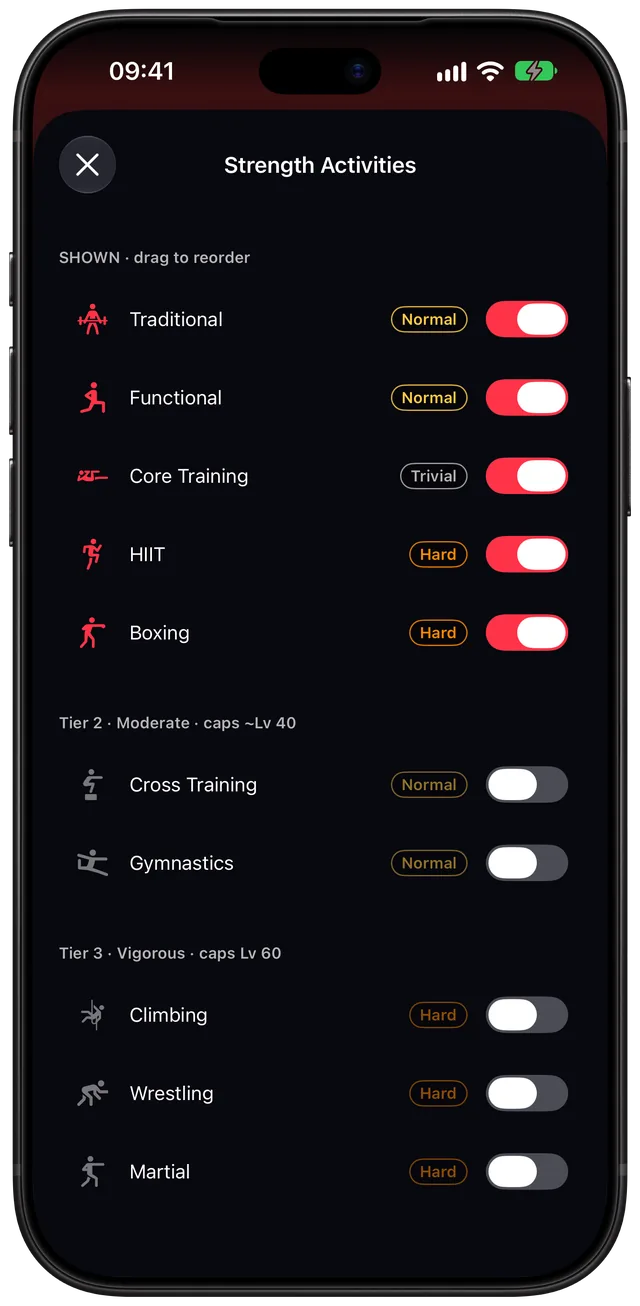
- Harder as you grow. Each of six stats levels from 1 to 60. Every activity carries a difficulty for your level: one that is hard for you pays more, and one you have outgrown pays nothing.
- A miss that costs a little. One session of five minutes or more lights the day for Momentum, which adds 1% bonus XP per day in a row, up to 50%. A missed day takes two days off the count instead of resetting it. A neglected stat loses XP at night, but never a level.
- Goals with a deadline. There are 57 written quests. You can run three at a time, with a daily rotation and urgent quests on top.
- Workouts you already record. Switch on Import Other Workouts and runs from other apps or Apple's Workout app arrive from Apple Health as sessions, starting the day you switch it on. Workouts it already has are skipped, so nothing counts twice.
- More than one kind of training. Strength, Endurance and Agility cover the body, while Wisdom, Spirit and Willpower cover reading, quiet practice and daily habits. Your character level is your lowest stat, so the one you skip shows. The guide to levelling up in real life explains the six stats.
- Someone to play against. CharacterSheet has no friends list or leaderboard. If competition is what moves you, run an Activity competition alongside it.
If you would rather set the rules up yourself first, how to gamify your workouts shows a version that runs on paper.
Which tool fits which problem
| Your problem | What helps | See |
|---|---|---|
| You want a free start | Activity rings and awards | Built in |
| You have a friend who would play | A 7-day Activity competition | Built in |
| The rings stopped meaning anything | Levels that get harder | Question 2 |
| One missed day ends everything | A miss that costs a little | Question 3 |
| You lift, swim or stretch, not just walk | Scores per kind of training | App |
Frequently asked questions
How do you gamify fitness?
Give your training points, add them up into levels that get harder, set a streak or goal with a deadline, and make a missed day cost a little. With an Apple Watch you can start with the Activity rings, awards and a 7-day competition with a friend. A fitness game app adds levels, quests and stats on top.
What is the best gamify fitness app?
It depends on what stopped working for you. If you have a friend who would play, Apple's Activity competitions are free, and competition was the game rule with the most lasting effect in a large trial. If you want levels that get harder, quests and separate scores for strength, cardio and flexibility, CharacterSheet is a subscription fitness RPG with a free trial.
Does gamification actually make you exercise more?
In trials, yes, by a modest amount. Families playing a game where a missed goal cost points added 1,661 daily steps over 12 weeks against 636 for controls, and in the STEP UP trial competition added 920 daily steps. The effect shrank after the games stopped, so pick a game you can keep playing.
Can I gamify my fitness tracker?
An Apple Watch already gamifies movement with three rings, awards for records and streaks, and 7-day competitions where you earn up to 600 points a day. An app that reads your workouts from Apple Health can add levels and quests on top without a second timer.
How do Apple Watch competitions work?
You invite a friend through Sharing in the Activity app, then choose Compete. The competition lasts 7 days, and you get a point for every percent you add to your rings each day, up to 600 points a day and 4,200 for the week. The person with more points at the end wins.
Sources
- Patel et al., JAMA Internal Medicine (2019): STEP UP randomized clinical trial of gamification with support, collaboration and competition
- Patel et al., JAMA Internal Medicine (2017): BE FIT randomized clinical trial of a game-based intervention among Framingham families (full text on PubMed Central)
- Apple Support: Share your activity with Apple Watch (competitions)
- Apple Support: Track daily activity with Apple Watch
- Apple: iOS 27